
History
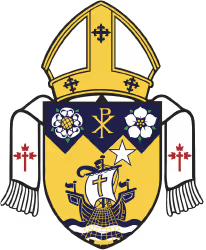
Heraldry originated about a thousand years ago in Europe, where it was used by the warrior classes as a means of differentiating combatants on the field of battle. As Europe developed and the feudal warrior class disappeared, the practice of identifying one’s possessions with personal emblems flourished. Ecclesiastical heraldry grew out of this practice, initially to differentiate between the various degrees of the clerical estate. The Pope and most bishops adopt a personal coat of arms, which today is used primarily to identify communications from their particular office. Archbishop Richard Smith adopted his personal coat of arms when he was appointed Bishop of Pembroke, Ontario.
Symbolism
The symbols of the upper portion of the shield represent the family origins of Archbishop Smith. The rose stands for his English (Smith) descent: and the shamrock for his Irish (Butts) ancestry. Symbolized in the lower section are the mainstays of his life in Christ. The wheat and grape signify the Eucharist, the source and summit of the Christian Life (cf. Sacrosanctum concilium, 10). The blue background honours the Blessed Virgin Mary, “our mother in the order of grace” (Lumen gentium, 61).
4885 Saint John Paul II Way, Vancouver, BC V5Z 0G3
Phone: (604) 683-0281 | Fax: (604) 683-4288
4885 Saint John Paul II Way, Vancouver, BC V5Z 0G3
Phone: 604 683 0281
Fax: 604 683 4288