
A policy provides a guide for meeting Archdiocesan objectives and describes the steps to be taken when carrying out a particular service or ministry. It is a documented set of basic principles and associated rules that guide decisions for accomplishing the common good. Carefully formulated and correctly implemented, a policy leads to greater efficiency, reduces the risk of errors, provides accountability, ensures transparency, offers clarity and consistency, and guarantees adherence to civil and canon law. A policy may include a procedure of step-by-step instructions on how to perform a task.
A. What Makes a Good Policy?
A policy generally contains certain standard components:
- Purpose: The reason for and the desired effect or outcome of the policy
- Background: Historical information justifying the creation of the policy
- Specifics:
- Offices and/or people that are impacted
- Required behaviour
- Processes to be followed
- Regulations, both internal and external
- Definitions: Clear explanations of key terms and concepts
- Implementation:
- The person(s) responsible for carrying out the individual policy
- How policy adherence will be ensured
- Effective Date: Date on which the Archbishop signs the policy into force
- References: Other documents or applicable laws and regulations
- Forms: Relevant to the processes outlined such as agreements, applications, contracts, etc., client information forms or other documents.
B. Archdiocesan Policy Administration
The Chancery Office administers Archdiocesan policies. Its responsibilities include:
- To review current policies to ensure that they are up-to-date;
- To identify policy gaps;
- To assemble information and provide analyses for the development of new policies;
- To act as a central information source by maintaining and distributing policies, procedures and forms; and
- To guide the process of creating and revising policies.
C. Development of a New Policy
1. Initiation
The need for a new or revised policy can be identified by any Archdiocesan employee or committee. If an issue is not sufficiently addressed by the teaching of the Catholic Church, by its universal law or by policies and procedures already ratified for similar circumstances, then the employee or committee may present a proposal to the director responsible for the office(s) affected by the policy.
The director, in turn, is to discuss the proposal with his or her delegate/vicar. If the delegate/vicar concurs, then the delegate/vicar presents the proposal to the Archbishop.
2. Draft
If the Archbishop agrees that a new or revised policy is warranted, then it is the director’s responsibility to have a draft policy prepared for review. Depending on the complexity of the policy, the director could assign the task to the initiating employee or form a committee for a more thorough review.
3. Format and Filing
Once the policy draft is complete, it is to be forwarded to the Chancery Office which will:
- Verify that the policy is either a new policy or a revision;
- Format the policy document, using the approved template, and:
- Mark the header of the policy document with "DRAFT" in red, until such time as the policy is approved and comes into effect;
- Determine the appropriate section and subsection;[1]
- Add the name of the policy draft to the Policy Control spreadsheet, filling in the required information and indicating the status as “Approval Pending”; and
- Forward the policy draft (and the policy the draft is replacing, if applicable) to the Archbishop.
4. Consultation
The type of policy and degree of complexity will dictate the level of consultation required with appropriate staff or committees prior to the Archbishop’s approving or rejecting the proposed policy.
5. Approval
Only the Archbishop approves policies and procedures intended to apply to the entire John Paul II Pastoral Centre or to the Archdiocese of Vancouver. The only exceptions to this rule are routine office procedures and special decrees issued by delegates/vicars that clarify the manner in which Archdiocesan policies are observed, or to urge their observance.
6. Circulation
The Chancery Office will be responsible for ensuring that the newly approved policy is placed into circulation and, if applicable, the superseded policy is removed from circulation.
Placing into Circulation
- The newly approved and signed paper document is filed in the Archives Office.
- A PDF copy of the approved document is sent to the initiator of the policy and/or the director of the office responsible for upholding the policy. One of these individuals will circulate the policy to the appropriate stakeholders.
- A PDF copy of the approved document is sent to the Communications Office to be uploaded to the appropriate section of the Policies & Procedures webpage on the Archdiocesan website www.rcav.org.
- In addition, the webmaster is to send an email notification to all members of the Archdiocesan community advising them that a policy has been uploaded to the website and providing them with a link to the policy.
Removing from Circulation
- The Archives Office is to be notified when a policy has been abrogated or superseded so that it can be removed from the current files and marked appropriately for retention in perpetuity as an historical record.
- The webmaster is to be notified when a policy has been abrogated or superseded so that it can be removed from the website.
7. Enforcement
In the Archdiocese, policies are enforced at the level at which the policy applies.
8. Administration Procedures for Filing New Policies
All policies are filed both electronically and in paper files. The following steps are required to ensure that new policies and superseded policies (if applicable) are filed properly.
New Policies
- Provide the signed paper copy to the Archives Office.
- File the PDF copy of the approved document according to subject in the Policy directory located on the Departmental_Shared networked drive. Policies are filed by their official name and the effective date in the following format: YYYY-##MMM-DD.
- In the Policy Control database, change the status of the new policy from "Approval Pending" to "In effect" and record the date it became effective.
Superseded Policies
Once the revision draft is approved, the current policy is superseded and is no longer effective.
- Advise the Archives Office that the policy has been superseded so that it can be marked appropriately for retention in perpetuity as an historical record.
- In the Policy directory on the Departmental_Shared network drive:
- Delete PDF copy of the approved document;
- Rename the WORD version of the policy, adding "- SUPERSEDED" to the name;
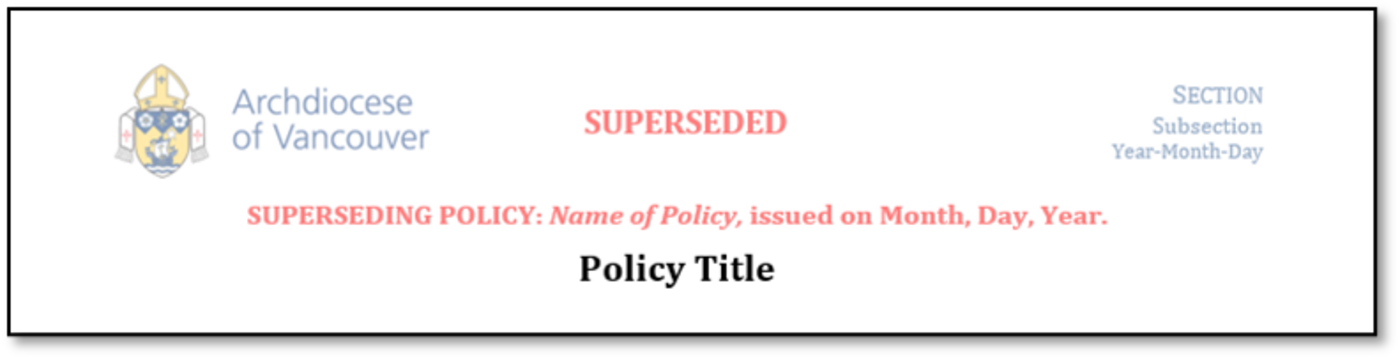
- Modify the header of the WORD version of the policy: In red, add "SUPERSEDED" and indicate the name of the superseding policy:
Abrogated Policies
When a policy is abrogated, it is no longer effective.
- Advise the Archives Office that the policy has been abrogated so that it can be marked appropriately for retention in perpetuity as an historical record.
- In the Policy directory on the Departmental_Shared network drive:
- Delete PDF copy of the approved document;
- Rename the WORD version of the policy, adding "- ABROGATED" to the name;
- Modify the header of the WORD version of the policy: In red, add "ABROGATED" with the date of abrogation:

- Change the status of the abrogated policy in the Policy Control database to "Abrogated" and indicate the date of abrogation.
- Approved: Memorial of Saint John Eudes
- Change the status of the superseded policy in the Policy Control database to "Superseded" and indicate the name of the superseding policy and the date it became effective.
- August 19, 2022+
+ J. Michael Miller, CSB
Archbishop of Vancouver
The following policy is hereby superseded:
Policy Development Process, issued on February 25, 2021.
[1] Sections and subsections are limited to a list approved by the Archbishop.